
Building an Atlantic Crossing Spares Kit: What to Carry and What to Leave Behind
Published
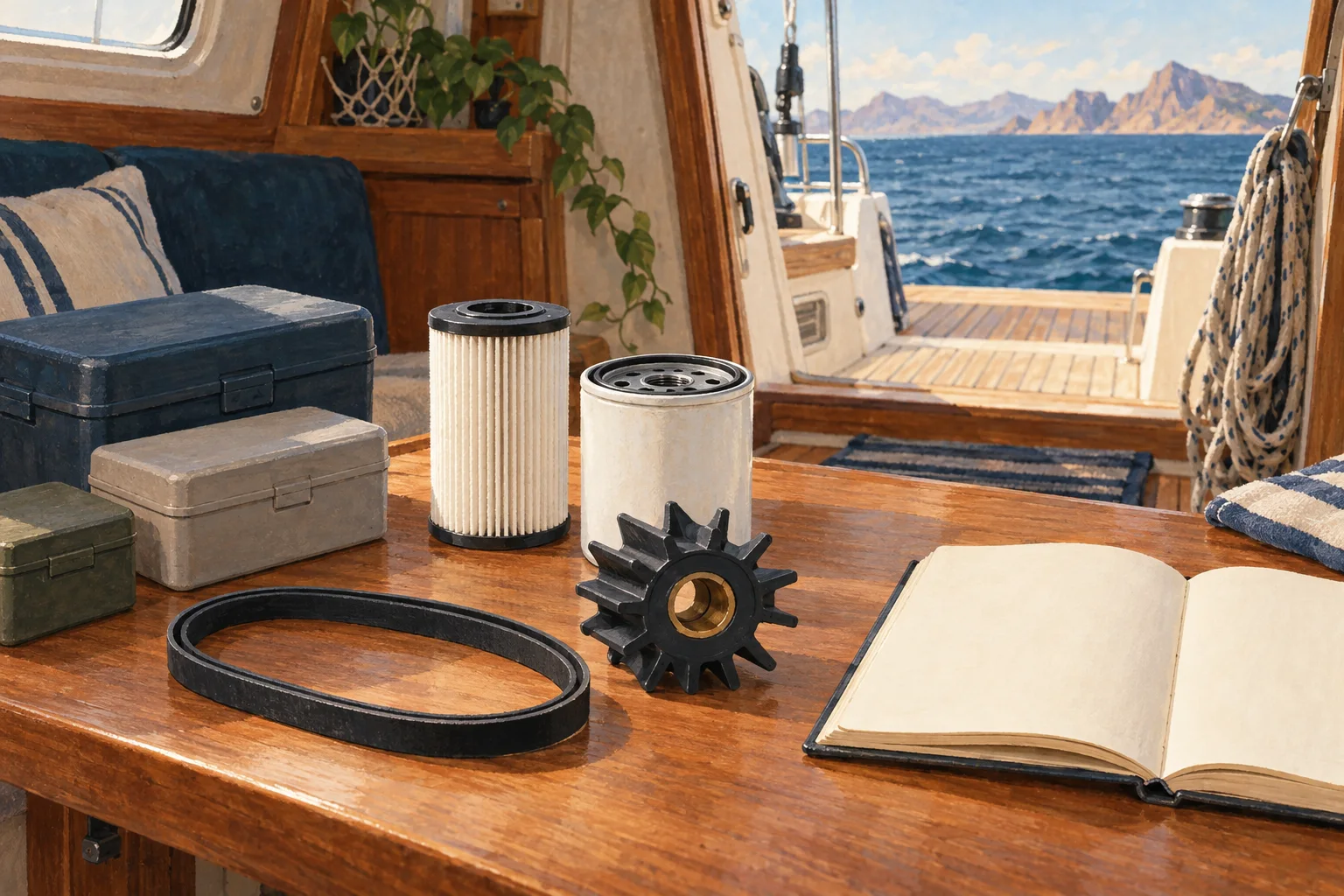
A locker full of spares can still leave you unable to complete a repair. The filter fits, but its seal is missing. The replacement pump is correct, but its connectors are different. The useful question before an Atlantic crossing is therefore: which jobs can this kit actually let us finish?
Build the list around the equipment installed aboard, the functions you need to preserve and the work your crew can perform. This guide provides a purchasing and packing method; use each equipment manual for the repair itself. ARC entrants should also check the 2026 rally handbook.
Start with the boat, then rank the jobs
Walk through the boat with a notebook. Record each essential system’s make, exact model, relevant serial number, power supply and manual location. Include separately fitted equipment: an engine’s external fuel separator, for example, needs its own entry. Record modifications rather than assuming the original boat specification remains accurate.
For each proposed spare, answer three questions: what stops working without it; can we complete the replacement aboard; and what functioning alternative remains? Use the answers to sort your list:
| Consequence and repairability | Packing decision |
|---|---|
| Important function lost; crew can perform a documented replacement | Prioritise the matching part, tools and installation consumables together. |
| Important function lost; replacement requires unavailable skills or equipment | Resolve the weakness before departure and establish a workable fallback. A loose spare alone provides no recovery. |
| Function remains available through an independent alternative | Compare the spare’s space and cost with the limitations of that alternative. |
| Comfort item; living without it is acceptable | Put it behind essential repairs unless it shares a useful common part. |
This is a decision framework, not a claim about which parts fail most often. A small item that serves several confirmed compatible installations can justify its space; a near-match cannot.
Engine, fuel and water: assemble complete job kits
Yanmar offers maintenance kits by engine range. Treat a kit as a starting point and check its contents against your actual installation.
List primary and engine-mounted fuel-filter elements separately, with their specified seals. Add oil-service materials if your planned engine hours bring a service due, the correct drive belts, and cooling-system service parts selected from the fitted equipment’s manual. Record approved oil and coolant specifications alongside quantities, rather than simply writing “engine fluids”.
For a raw-water pump, identify the pump itself. Jabsco’s guide points to the pump data sheet for the impeller reference. Check the job also has its required cover gasket or O-ring, lubricant and the tools to reach its fasteners. A pump changed during an earlier refit may invalidate an old engine-based shopping list.
Lay out the tools for each job in port: suitable spanners and sockets, a filter wrench or impeller puller where specified, lighting, a collection tray and absorbents. Check access with the engine stopped and isolated according to its manual.
Apply the same method to freshwater and bilge pumps: identify the fitted model, relevant service parts, connections and access. Decide whether a complete interchangeable pump offers a repair your crew can realistically make, or whether the manufacturer’s service kit is more useful. A “universal” box of hose and seals is difficult to assess; list hose sizes, service requirements and compatible fittings against named jobs instead.
Electrical spares: record more than amperage
Blue Sea distinguishes current, voltage and interrupt ratings, as well as fuse operating speed. Record the specified fuse type and ratings for each relevant circuit, then buy labelled replacements from that list.
Include suitable connectors, terminals and insulating materials only for the documented repairs your crew can undertake, with the matching crimping and testing tools. Keep a readable circuit list with the kit. Do not increase a fuse rating to keep equipment running; repeated operation of circuit protection requires fault-finding. A bag of fuses is not a substitute for resolving an electrical defect before departure.
Sails, deck gear and steering: match the installed hardware
A North Sails offshore brief includes needles, thread, webbing and sail patches. Select compatible materials with your sailmaker, and practise using the complete kit.
For sail-handling gear, make a short list of the actual sliders, pins, retaining rings and other service parts fitted aboard. Confirm load-bearing replacements against the equipment specification. Lewmar’s maintenance pack includes pawl springs and dedicated winch lubricants; verify suitability for your winch model rather than assuming one pack covers everything.
Steering deserves its own entry. Edson’s CDi kit is specifically for its geared steering system. Identify your system and select its documented service parts; treat the autopilot as separate equipment. Keep emergency-steering preparation on the departure work list, not hidden inside a spare-parts order.
Set quantities with an explicit assumption
Separate planned consumption from contingency stock. Planned consumption follows your service schedule and passage assumptions. Contingency stock reflects the consequence of running out, the available alternatives, your equipment history and storage capacity. Record that reasoning so another crew member can review it.
For example, suppose your plan allows one scheduled filter change and two contingency changes, and your separator needs one element per change. That produces three elements, with the corresponding seals. These are illustrative planning inputs, not a recommended quantity for every crossing. Calculate the engine-mounted filter separately; it may have a different reference and schedule.
A small inventory you can expand
Here is a worksheet for a hypothetical boat with an inboard diesel, electric freshwater pump and conventional winches. The reference column deliberately tells you where to obtain the real number; it does not invent one.
| Kit | Item and reference to confirm | Decision to record |
|---|---|---|
| Engine-01 | Primary fuel-filter element and seals; separator parts list | Planned changes plus contingency; packing location and count. |
| Cooling-01 | Raw-water impeller and associated seals; fitted pump data sheet | Complete replacement job, including required access tools. |
| Electrical-01 | Fuses; approved circuit list and equipment manuals | Quantity of each specified type and rating, separately labelled. |
| Water-01 | Pump service kit or complete pump; installed model documentation | Which option the crew can fit with the connections aboard. |
| Deck-01 | Winch service parts; exact winch model’s parts list | Compatible contents and the tools needed to retain and handle small parts. |
Give every row an owner and a status: reference confirmed, ordered, received, checked, packed. “Ordered” is not “aboard”. Before buying, check whether a kit already contains a component listed elsewhere.
Pack for retrieval, and remove dead weight
Pack dry parts in labelled, protected containers by job. Put the inventory and locker location in an offline file, with a paper copy where the crew can find it. Keep frequently needed kits accessible without unloading an entire berth. Record expiry dates for products that have them and check packaging condition.
Motul recommends keeping oil tightly sealed in its original container, away from heat, light and moisture. Secure fluids separately from clean repair materials, food and paper records, with secondary containment suitable for the product. Follow each product’s storage instructions.
Remove unidentified leftovers, expired consumables and duplicates that fit equipment no longer aboard. Question large spare assemblies when nobody can install them or when the chosen fallback already meets the need. Conversely, a proven, installable spare for an essential system may deserve its weight. Make that decision explicitly.
Finish the pre-departure work list, practise the planned jobs in port and replenish anything used. Then use the Canary Islands sourcing guide for the remaining confirmed references. You are ready to pack when every chosen spare has a purpose, a matching installation and a credible way to use it.
Sources checked on 13 October 2026. The prioritisation matrix, quantity example and inventory workflow are Joshua Supply’s editorial framework.
Cover image: AI-generated illustration, not a photograph of an inspected kit.